Joan Baez has never needed a spotlight to make her presence felt. For more than six decades, her voice has carried far beyond concert halls, echoing through the streets of social movements, civil rights marches, peace rallies, and humanitarian campaigns around the world. This week in California, that voice—and the spirit behind it—was honored with a prestigious humanitarian award recognizing her lifelong commitment to justice, dignity, and human compassion.
The ceremony, held at a packed auditorium in the Bay Area, brought together fellow artists, activists, public officials, and generations of admirers who have been touched by Baez’s courage and conviction. The evening felt less like an award presentation and more like a historical moment—a collective acknowledgement of a woman whose influence has shaped the moral landscape of multiple eras, from the 1960s to today.

A Legacy Rooted in Justice and the Power of Nonviolent Resistance
Joan Baez’s humanitarian legacy is inseparable from her music, but it cannot be defined by it alone. Long before she stepped on a stage, she was raised in a family that believed in the value of peace, human dignity, and standing up for those without a voice. That upbringing set the foundation for a lifetime of activism that would ripple far beyond anything she could have imagined as a young woman.
Her support for the Civil Rights Movement became one of the earliest defining chapters of her career. Baez marched with Dr. Martin Luther King Jr., performed at rallies and voter registration events, and used her platform to amplify demands for racial equality at a time when doing so was both risky and uncommon for mainstream entertainers. Those early acts of bravery established her reputation as not just a musician, but a moral force—someone who refused to look away from injustice even when the world urged her to.
From Vietnam to Human Rights Watch: A Global Humanitarian Force
The award ceremony highlighted Baez’s extraordinary global reach. In the 1960s and 70s, she became one of the most prominent voices against the Vietnam War, using both her art and her direct action to push for peace. She co-founded the group Humanitas International, which exposed human rights abuses around the world long before such issues became central in global politics.
Her humanitarian work has taken her to refugee camps, conflict zones, and international summits. She has stood with political prisoners, advocated for immigrants, spoken for victims of torture, and consistently challenged the powerful to do better. Even as music brought her fame, her activism brought her purpose.
One speaker at the California ceremony remarked, “Joan Baez does not simply support causes—she lives them.”
And indeed, her activism has never faded. From supporting environmental justice to advocating for women’s rights, LGBTQ+ rights, and prison reform, Baez’s humanitarian mission has remained unwavering.
A New Generation Inherits Her Voice
What made the award especially poignant was the recognition that Baez’s influence spans generations. Younger activists in attendance—many inspired by movements like Black Lives Matter and climate justice—spoke about how her example shaped the way they think about protest, integrity, and the responsibility to use one’s voice.
For many of them, Baez is more than a historical figure. She is proof that activism rooted in compassion can withstand time, political cycles, and generational change.
Her refusal to compromise her principles, even when pressured by institutions, record labels, or governments, continues to resonate with those seeking to make change in today’s fractured society.
A Legacy That Extends Far Beyond the Stage
Throughout the ceremony, attendees reflected on the profound emotional impact of Baez’s work. Her music has become the soundtrack of countless movements, but her humanitarian efforts have become a guiding light for countless lives.
The humanitarian award she received is not simply a recognition of past achievements—it is an acknowledgment of the moral clarity she has brought to some of the darkest chapters in modern history.
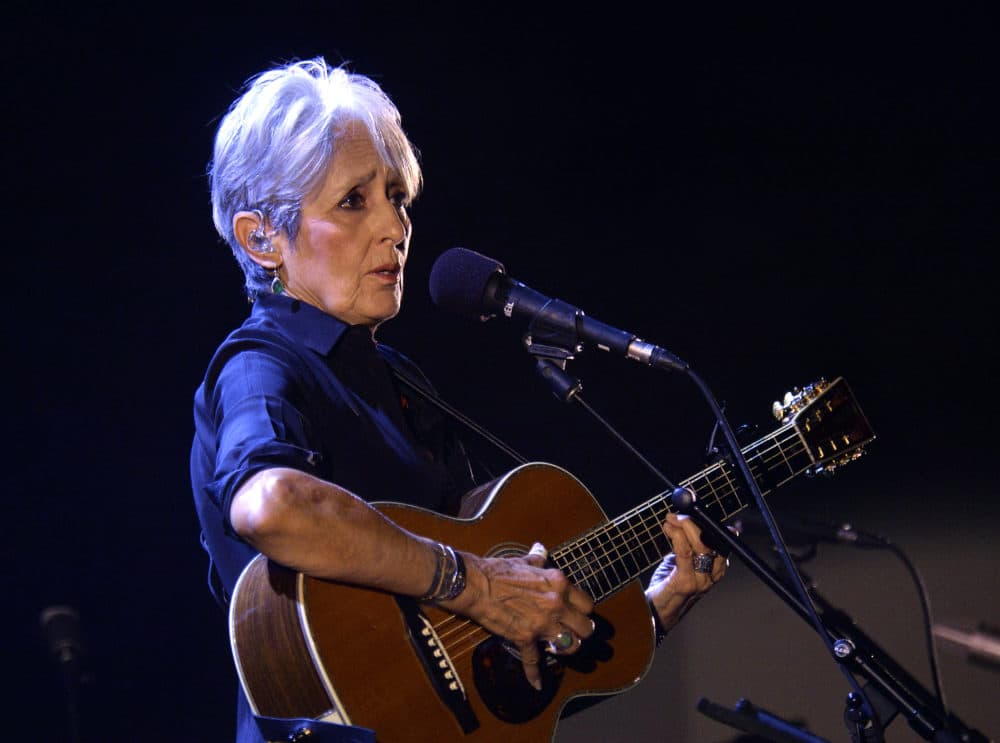
As she took the stage to accept the honor, Baez spoke with her signature humility. She did not talk about awards or legacy, but about people—those she walked alongside, those she fought for, those who inspired her, and those who continue the work today.
“My journey has always been about compassion,” she said. “It’s about seeing the humanity in others, especially when the world tries to erase it. We are here to care for each other. That is the heart of every struggle I have ever been part of.”
Her words earned a long, emotional standing ovation.

A Life That Redefined Activism
Joan Baez’s award is more than a celebration—it is a reminder. A reminder that activism is not a phase, but a lifelong commitment. A reminder that compassion is not weakness, but power. A reminder that a single voice, when guided by courage and integrity, can change the course of history.
As the ceremony drew to a close, attendees agreed on one thing: Joan Baez didn’t just contribute to humanitarian causes—she helped define what it means to be a humanitarian in the modern world.
And now, with this award, California has honored a woman who spent her life honoring others.