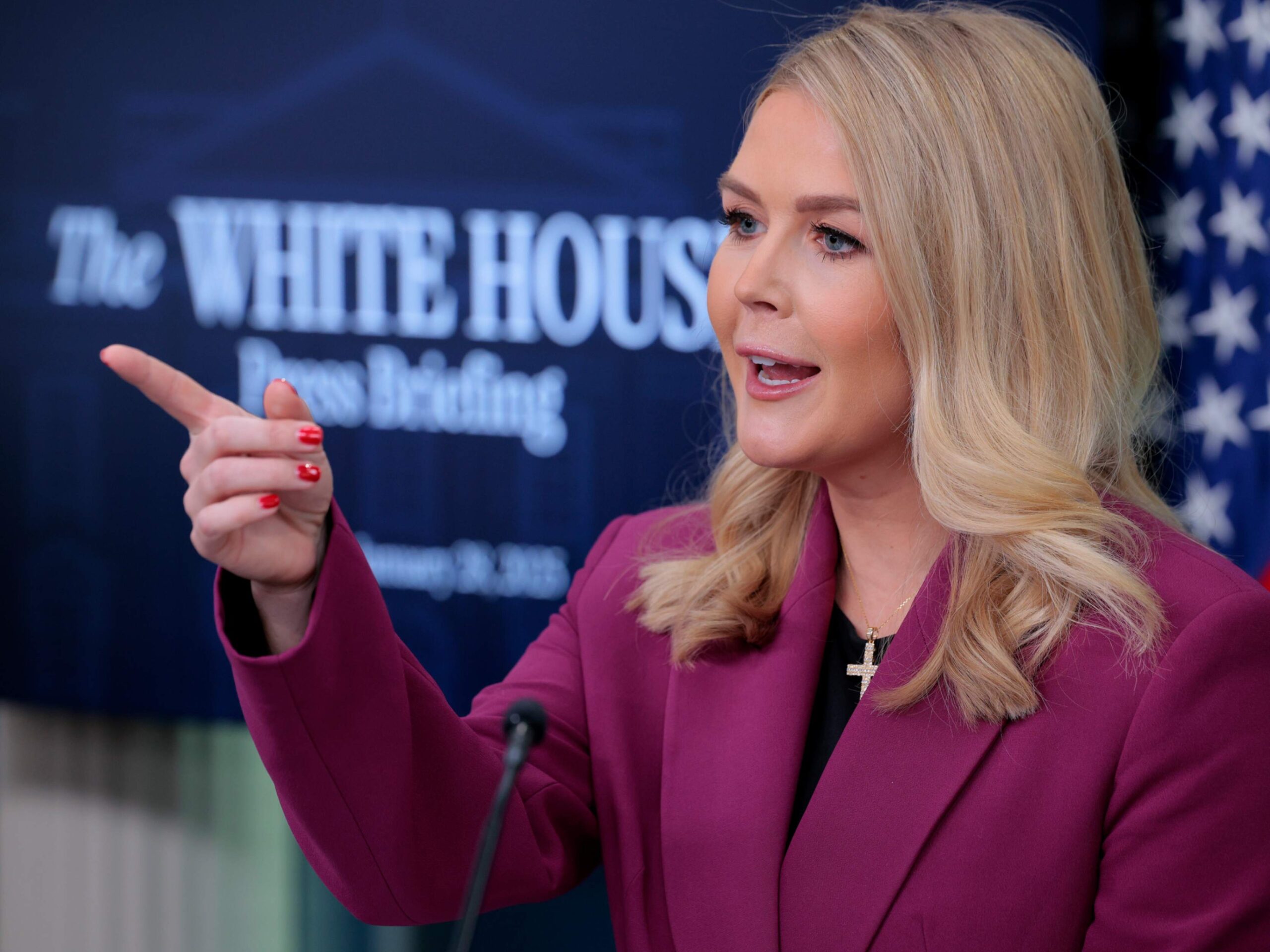
White House Press Secretary Karoline Leavitt pushed back forcefully on Monday after a federal judge delivered a stunning ruling that dismissed criminal cases against two of Donald Trump’s most outspoken critics. The judge’s decision — which declared that interim U.S. Attorney Lindsey Halligan lacked the legal authority to bring the charges — ignited a political firestorm that now threatens to ripple far beyond Washington’s legal circles.
In a brief but sharp exchange with reporters, Leavitt insisted that Halligan had been “lawfully installed” and that the administration would “vigorously challenge” the ruling. Her remarks came just hours after the federal court issued its opinion, wiping out ongoing criminal proceedings against former FBI Director James Comey and New York Attorney General Letitia James. Both have clashed publicly with Trump for years, making the cases politically explosive from the outset.
The judge’s decision immediately sent shockwaves through the capital. Legal analysts scrambled to interpret the implications, while political commentators called it a major setback for the administration’s ongoing efforts to prosecute figures it has repeatedly accused of political misconduct. The ruling centered on whether Trump had the authority to appoint Halligan — a longtime ally — as interim U.S. attorney without Senate confirmation.
According to the opinion, Halligan’s appointment violated federal vacancy laws, rendering her actions in office “void from the start.” It was a harsh assessment, and one that provided Comey’s and James’s legal teams with a decisive victory. The court stated that because Halligan lacked legitimate authority, the charges she filed could not stand, no matter the underlying facts.
Still, the White House was quick to counter. Leavitt, appearing unusually combative, argued that the ruling was “legally flawed,” asserting that presidents have historically exercised broad discretion in naming interim prosecutors. She suggested that the court had “overstepped,” setting the stage for what may become a defining separation-of-powers battle.
As she spoke, Leavitt portrayed Halligan as an unfairly maligned public servant caught in the crossfire of partisan hostility. “She followed the law, she followed the Constitution, and she followed her oath,” Leavitt declared. “To claim otherwise is not only inaccurate — it’s dangerous.” Her tone underscored the administration’s resolve to defend both Halligan and the underlying investigations.
But critics dismissed the press secretary’s statements as political theater. Several former Justice Department officials immediately pushed back, arguing that the administration had ignored long-standing legal norms by elevating Halligan without Senate input. They also emphasized that the judge’s ruling reflected growing concerns that federal law enforcement was being used to settle political grievances rather than uphold impartial justice.
Meanwhile, supporters of the defendants wasted no time celebrating the decision. For Comey, the ruling marked the collapse of yet another attempt to revisit his role in past investigations involving Trump. Letitia James, whose legal battles with the former president have been both highly publicized and deeply personal, issued a brief statement calling the dismissal “a victory for the rule of law.”
Behind the scenes, however, the administration faces mounting pressure. The Justice Department must now decide how to proceed: appeal the decision, seek to refile charges under a different U.S. attorney, or drop the cases entirely. Each option carries political risks, and the controversy has already reignited debates about the independence of federal prosecutors.
The political stakes are even higher considering the timing. With the presidential election season accelerating, every legal confrontation involving Trump or his allies is being scrutinized through an intensely partisan lens. Republicans have accused the judiciary of undermining the administration to shield its political opponents, while Democrats argue that the president is attempting to weaponize federal authority to target critics.
The broader public reaction has been predictably divided. Conservative commentators lambasted the judge as an “activist,” while progressive analysts framed the ruling as a necessary check on executive overreach. Social media erupted with competing hashtags, reflecting a national conversation that has grown increasingly polarized.

Nevertheless, the heart of the issue may be more procedural than political. Legal scholars note that the Vacancies Reform Act, which limits who can serve in key federal roles without Senate confirmation, has been a source of controversy for decades. The law’s ambiguous language has led to conflicting interpretations under multiple administrations, Democrat and Republican alike. Halligan’s appointment appears to be the latest flashpoint in a long-running legal debate.
But Monday’s ruling has pushed the issue into the national spotlight with unprecedented intensity. If the administration challenges the decision — as Leavitt promised — the case could ultimately reach the Supreme Court. A high-court decision could reshape the limits of presidential power, affecting not just the current administration but every one that follows.
For now, the White House appears determined to stand its ground. Leavitt’s firm tone and categorical defense signaled an administration unwilling to concede even an inch of legal or political territory. “We will appeal,” she stated plainly. “And we expect to win.”
Whether they will remains an open question. But one thing is clear: the clash between the judiciary and the executive branch has escalated dramatically, and the fallout is only beginning.